Why not just use my AI agent?
For a quick look, your agent is enough. For a review a team will act on, here is what DocReview adds.
The straight answer
If you already use an AI agent or chat assistant (ChatGPT, Claude, Copilot, Codex, an agent harness on your own model), it can review a document for you, and for many people that is enough: a short document, a quick second opinion, a question about one clause. Keep using it.
DocReview is for the other case: a long document that a team has to act on, reviewed again when the next version arrives. There the work is not only finding issues. It is reading every section, quoting the document exactly, ranking what matters, putting each comment where the author will see it, and remembering what was raised last round. A general agent can be pushed toward some of that with careful prompting; DocReview does it the same way every time.
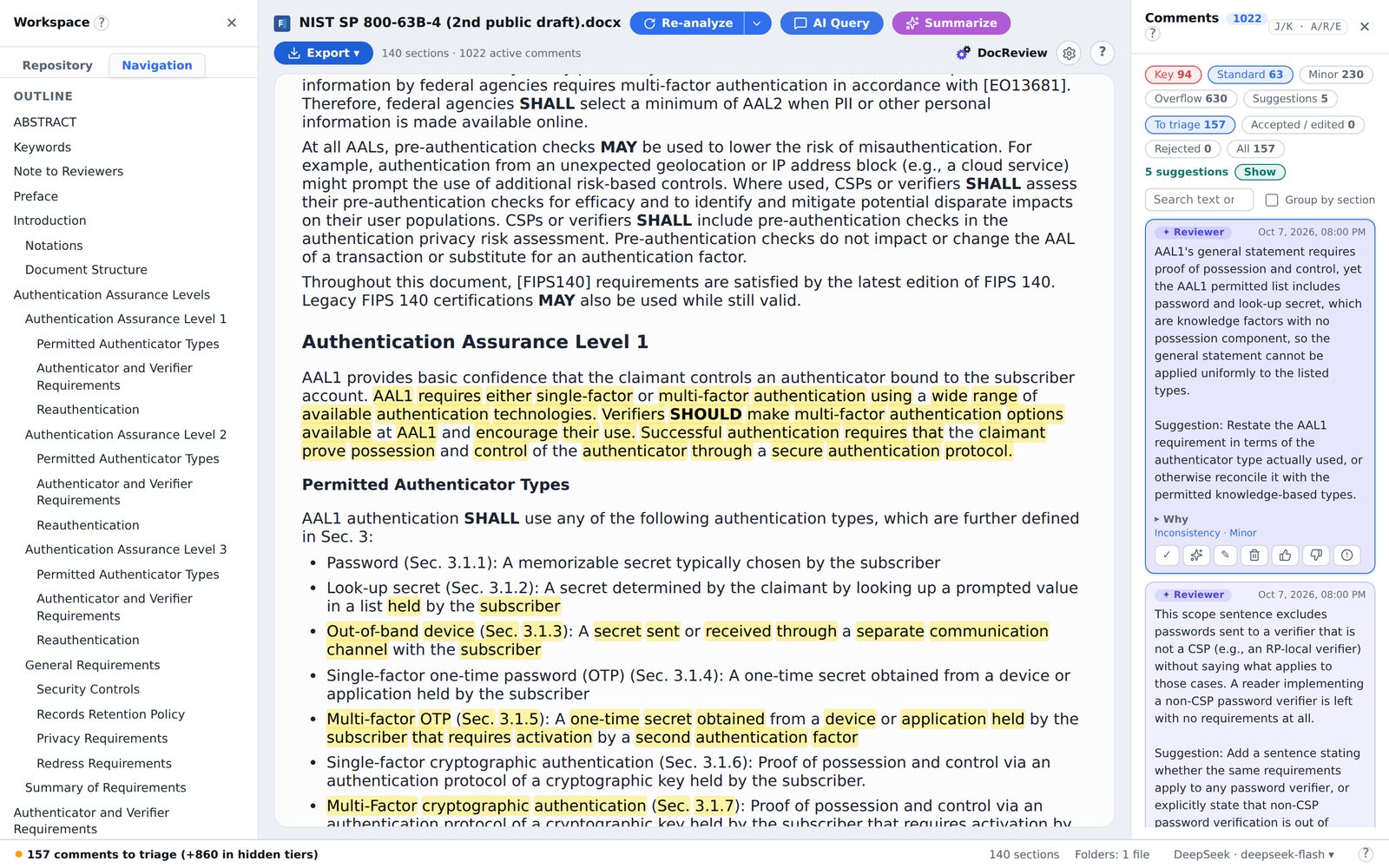
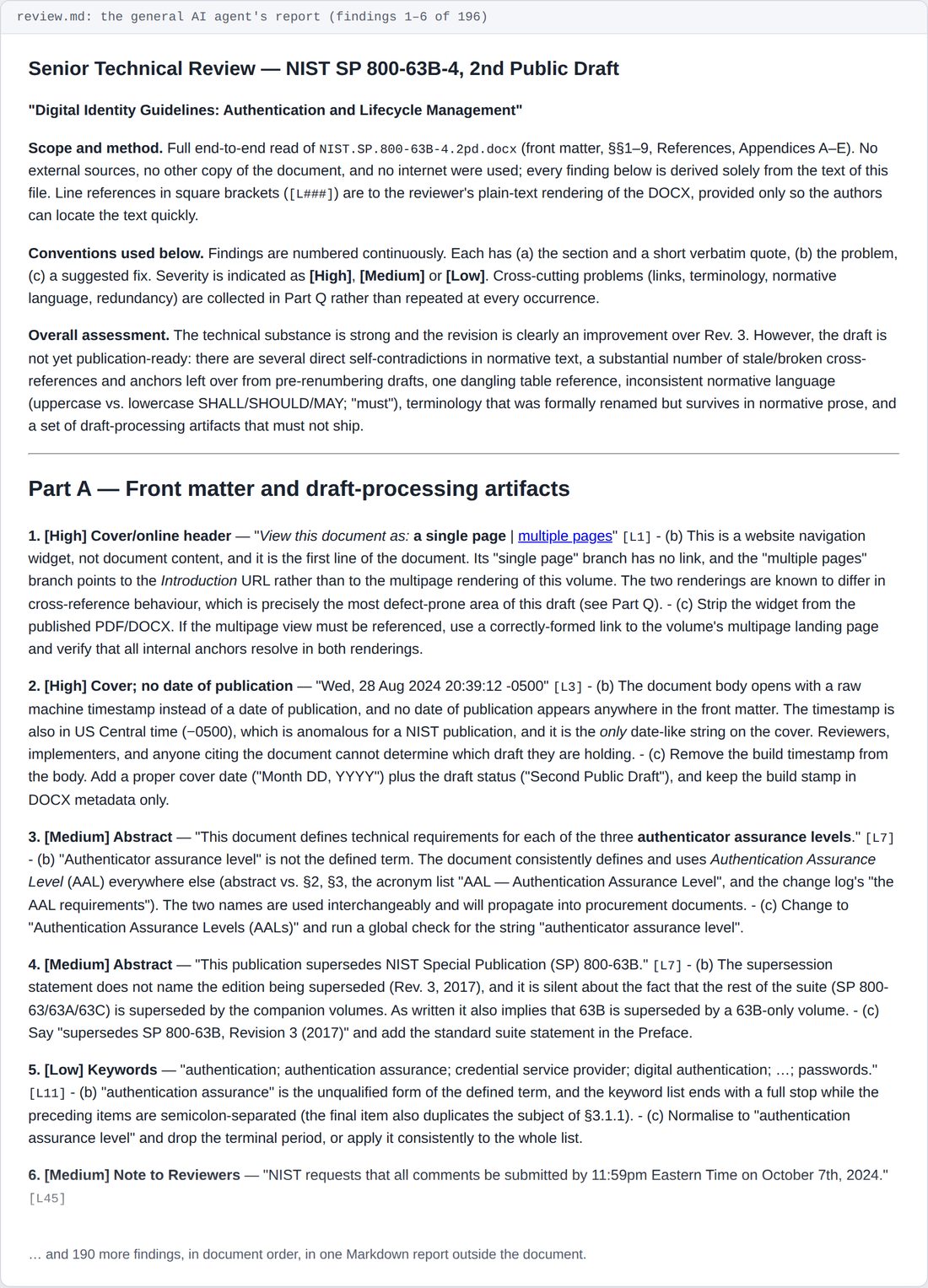
Same document, same model
NIST SP 800-63B-4, second public draft (about 36,000 words), reviewed by a general AI agent and by DocReview with the same cloud model and no internet access. The full benchmark.
What each one gives you
| General AI agent | DocReview | |
|---|---|---|
| A short document, a quick opinion | Fast and good | Works, but more than you need |
| Long documents | Depends on the session: it can skim, run out of context or stop early | Every section, one at a time, with a record of what was reviewed |
| Quotes | Can paraphrase or invent them (6 of 8 invented on a private model in our test) | Every comment anchored to text that exists in the document; quotes are checked |
| Where the result goes | A chat answer or a separate report | Comments inside the Word file, plus a comment resolution sheet and a review record |
| What matters first | Its own labels, in document order | Key, Standard and Minor, with a comment budget so the important ones are not buried |
| Mechanical checks | Whatever it happens to notice | Every time: broken references, numbering gaps, repeated words, totals that do not add up |
| Related files | Only what you paste or attach | Checks against the other files in your folder |
| The next version | No memory of the last round | Checks every open comment against the new version and carries over what is unresolved |
| Working through it | Copy, paste and track by hand | Accept, edit, reject or rate each comment; decisions are saved |
| Confidential documents | Depends on the tool and its model | Runs with a model on your own computer: nothing leaves it |
| Same process every time | Depends on your prompt | The same review steps on every document, scored on every release |
What we measured
| Same document, same model | Expert-confirmed defects found (of 12) | What you get |
|---|---|---|
| General AI agent, private model | 0 | 20 findings; 6 of its 8 quotes do not exist in the document |
| DocReview, same private model | 4 | 193 ranked comments inside the Word file |
| General AI agent, cloud model | 4 | 196 findings in one report |
| DocReview, same cloud model | 4 (+2 harder issues) | 225 ranked comments inside the Word file |
On a strong cloud model the two find about the same defects; the difference is what you can do with the result. On a private model, the kind many organisations must use for confidential documents, a general agent loses track and DocReview still reviews. Single runs on one public document, hand-scored; the method is on Why DocReview.
Use both
DocReview does not replace your assistant. Use the assistant for questions and drafting, and DocReview for the review a team will act on. Inside DocReview, AI Query answers questions about the open document with the passages it relied on.